Tag: pharma interview questions and answers for fresher
Quality assurance interview questions in pharma industry
Quality assurance interview questions
Before knowing the interview questions for QA job, you have to know the situation in interview pattern. Here we have provided the question and answers according to Quality assurance department point of view. But in actual times there is no rule to ask these type of questions only. Because you are a fresher and you have all the subjects in your B pharmacy like pharmaceutical analysis, pharmaceutics and medicinal chemistry etc.They may expect answers form you for other HPLC, UV etc principles methodology also. For your understanding about QA job and knowledge required for this job, we have provided QA job oriented knowledge related questions here.
You have to know the Quality control interview questions also before attending an interview for getting success.
1. Define quality assurance
Ans) QA is a broad range of concept contains all the matters that individually or collectively effect the quality of a product. QA mainly concentrated on planning and documenting the procedures to assure the quality of the product.2. Explain the difference between QC and QA?
Ans) QA provides the confidence that a product will full fill the quality requirements. QC determines and measures the product quality level.
3. Expand cGMP and what is the difference between GMP and cGMP?
Ans) cGMP known as Current Good Manufacturing Practices. It is a USFDA regulations to assure proper design , manufacturing and control of manufacturing processes and services.
GMP-Good Manufacturing Practices. These are the standard guidelines given by Food and Drug administration to make sure that a product is manufactured with safety and quality. c in cGMP means current. It refers to recent and advance updates to these standard guidelines. cGMP is up to date standard reference guidelines.
4) Tell me any five countries with their regulatory authorities?
Ans) India – Central Drugs Standard Control Organisation (CDSCO)UK – Medicines and Healthcare products Regulatory Agency (MHRA)
Japan- Ministry of Health Labour and Welfare (MHLW)
Australia- Therapeutics Goods Administration (TGA)
Brazil- ANVISA
5) Expand ICH? Tell me about ICH Guidelines?
The aim of the ICH is to enhance the harmonisation world wide to make sure that safe, high quality and effective drugs are developed and registered in the most efficient manner.
ICH provides guidelines on 4 aspects that is quality , safety , Efficacy and Multidisciplinary guidelines.
6) What is SOP?
SOP known as Standard Operating Procedure.
7)Expand IQ OQ PQ DQ
IQ- Installation Qualification
OQ-Operational Qualification
PQ-Performance Qualification
DQ-Design Qualification
8) Difference between validation and calibration
Validation produces the documented evidence assuring a specific procedure/procedure or activity consistently develops a product with predetermined specifications and quality credits. It is performed according to validation protocol.
Calibration denotes that an equipment produces the values in specified limits by comparing the values produced by a standard. It is done according the calibration standard operating procedure.
9) Expand BMR and BPR?
Ans) BMR – Batch Manufacturing Record , is prepared as a written file during the manufacturing a product by writing. Step by step manufacturing process and details about batch recorded here.
BPR Batch Packaging Record, is kept for every BMR. BPR is depends on packaging operation.
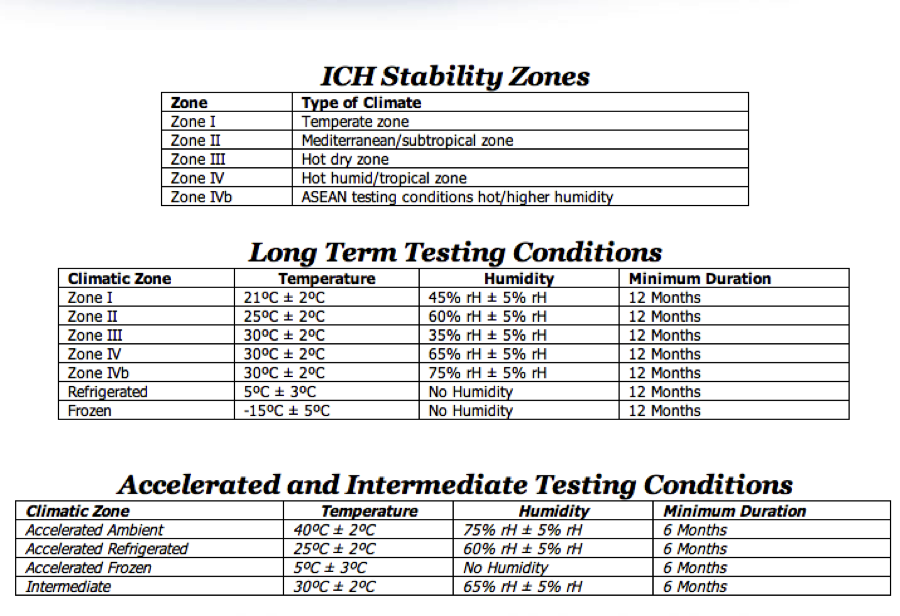
10) What do you know about stability studies?
Ans) These are necessary for developing the pharmaceutical products. It helps to evaluate the effect of environmental factors (e.g Light, Humidity, Temperature etc) on Active Pharmaceutical Ingredient(API) or Pharmaceutical formulation.11) What is the time period required for long term and accelerated stability studies?
Ans) Long term 12 months, Accelerated studies- 6 months
12) What are types of climatic zones? India belongs to which climatic zone?
Ans) India belongs to Zone III(Hot dry zone) and Zone IVb(Hot/Higher humidity)
FYI
QC Pharma Interview Questions For Freshers
QC pharma jobs offered for b pharmacy freshers in pharmaceutical
industry. Usually, first you should qualify an interview exam for
attending the interview. It is depend upon the which pharmaceutical
company you are trying for.
Here we have given most commonly asked basic questions in the qc pharma interview for freshers. There is no specific pattern/rule for asking the interview questions. Its purely an interviewer choice. But still we try to give qc pharma interview information which they are asking mostly based on some experienced interviewees suggestions.
We are not discussing any HR related questions except qc pharma technical questions.
Related: B pharmacy interview exam questions for freshers
Ans) 25 degree centigrade
Q2. What is the Ultraviolet(UV) and visible spectroscopy range?
Ans) UV spectroscopy range 200-400 nm, Visible spectroscopy range 400 nm to 800nm.
Q3) What is the use of UV Spectroscopy?
Ans) Spectroscopy used for detecting the functional groups, impurities. Qualitative and quantitative analysis can be done.
Q4) What is the difference between qualitative and quantitative analysis?
Ans) Qualitative analysis involves identification of the compound or chemical based on their chemical(absorption, emission )or physical properties(e.g Melting point, boiling point).
Quantitative analysis involves estimation or determination of concentration or amount of the chemical compounds or components.
Q5) Explain the principle of Ultraviolet spectroscopy?
Ans) UV spectroscopy uses light in the UV part of electromagnetic spectrum. UV absorption spectra arises in which molecule or atoms outer electrons absorb energy, undergoes transition from lower energy level to higher energy level. For each molecule, absorbance at wavelength is specific.
Q6) Explain about Beer Lamberts law?
Ans) It states that the intensity of monochromatic light absorbed by a
substance dissolved in a fully transmitting solvent is directly
proportional to the substance concentration and the path length of the
light through the solution.
Q7) Explain the Infrared spectroscopy principle?
Ans) When a molecule absorbs the Infrared radiation, it vibrates and gives rise to packed Infrared(IR) absorption spectrum. This IR spectrum is specific for every different molecule absorbing the IR radiation, useful for its identification.
Q8) What is the body temperature?
Ans) 37 oCelsius or 98.6 oF
Q10) Expand LCMS, HPLC,UPLC, TLC and GC?
Ans) LCMS- Liquid Chromatography
HPLC- High Performance Liquid Chromatography,
UPLC- Ultra High Performance Liquid Chomatography,
TLC- Thin Layer Chomatography,
GC- Gas Chromatography.

Q11) What is the HPLC principle?
Ans) It is a technique used for separating the mixture of components into individual components based on adsorption, partition, ion exchange and size exclusion principles. Stationary phase and mobile phase used in it. HPLC used for identification, quantification and purification of components form a mixture.
Q12) Explain HPLC instrumentation?
Ans) It involves solvent system, pump, Sample injector, HPLC columns, Detectors and Recorder. Firstly, solvent(mobile phase) is degassed for eliminating the bubbles. It is passed through the pump with a uniform pressure. The liquid sample is injected into the mobile phase flow stream. It passes through the stationary phase identified by the detectors and recorded.
Q13) In reverse phase HPLC, which type of stationary phase is used and give example?
Ans) Non polar stationary phase used
Ex: Silica gel C-18
Q14) What are the detectors used in HPLC?
Ans) UV detector, IR detector, Fluorescence detector, Mass spectroscopy, LC MS etc.
Q16) Define molarity?
Ans) Number of moles of solute per litre solution. Denoted with “M”
Q17) Define Molality?
Ans) Number of moles of solute per kilogram solvent. Denoted with “m”
Q18) Define Normality?
Ans) Number of Number of moles equivalent per litre solution.
Q19) Molecular weight of oxygen?
Ans) 16
Q20) Difference between humidity and relative humidity?
Ans) Humidity – Measure of amount of water vapour present in the atmosphere.
Relative humidity- Water vapour amount exists in air expressed as a percentage of the amount needed for saturation at the same temperature.
Follow this website for more qc pharma interview questions. If you have any queries comment below.
Here we have given most commonly asked basic questions in the qc pharma interview for freshers. There is no specific pattern/rule for asking the interview questions. Its purely an interviewer choice. But still we try to give qc pharma interview information which they are asking mostly based on some experienced interviewees suggestions.
We are not discussing any HR related questions except qc pharma technical questions.
Quality control interview Questions:
Q1. What is room temperature?Ans) 25 degree centigrade
Q2. What is the Ultraviolet(UV) and visible spectroscopy range?
Ans) UV spectroscopy range 200-400 nm, Visible spectroscopy range 400 nm to 800nm.
Q3) What is the use of UV Spectroscopy?
Ans) Spectroscopy used for detecting the functional groups, impurities. Qualitative and quantitative analysis can be done.
Ans) Qualitative analysis involves identification of the compound or chemical based on their chemical(absorption, emission )or physical properties(e.g Melting point, boiling point).
Quantitative analysis involves estimation or determination of concentration or amount of the chemical compounds or components.
Q5) Explain the principle of Ultraviolet spectroscopy?
Ans) UV spectroscopy uses light in the UV part of electromagnetic spectrum. UV absorption spectra arises in which molecule or atoms outer electrons absorb energy, undergoes transition from lower energy level to higher energy level. For each molecule, absorbance at wavelength is specific.
Q6) Explain about Beer Lamberts law?
Q7) Explain the Infrared spectroscopy principle?
Ans) When a molecule absorbs the Infrared radiation, it vibrates and gives rise to packed Infrared(IR) absorption spectrum. This IR spectrum is specific for every different molecule absorbing the IR radiation, useful for its identification.
Q8) What is the body temperature?
Ans) 37 oCelsius or 98.6 oF
Q9) Define pH? What is the pH of blood?
Ans) pH -Negative logarithm of hydrogen ion concentration. Blood pH-7.35 to 7.45.Q10) Expand LCMS, HPLC,UPLC, TLC and GC?
Ans) LCMS- Liquid Chromatography
HPLC- High Performance Liquid Chromatography,
UPLC- Ultra High Performance Liquid Chomatography,
TLC- Thin Layer Chomatography,
GC- Gas Chromatography.
Q11) What is the HPLC principle?
Ans) It is a technique used for separating the mixture of components into individual components based on adsorption, partition, ion exchange and size exclusion principles. Stationary phase and mobile phase used in it. HPLC used for identification, quantification and purification of components form a mixture.
Q12) Explain HPLC instrumentation?
Ans) It involves solvent system, pump, Sample injector, HPLC columns, Detectors and Recorder. Firstly, solvent(mobile phase) is degassed for eliminating the bubbles. It is passed through the pump with a uniform pressure. The liquid sample is injected into the mobile phase flow stream. It passes through the stationary phase identified by the detectors and recorded.
Q13) In reverse phase HPLC, which type of stationary phase is used and give example?
Ans) Non polar stationary phase used
Ex: Silica gel C-18
Q14) What are the detectors used in HPLC?
Ans) UV detector, IR detector, Fluorescence detector, Mass spectroscopy, LC MS etc.
Q15) How to calculate Retention factor in paper chromatography?
Ans) Rf = Distance travelled by solute/ Distance travelled by solvent.Q16) Define molarity?
Ans) Number of moles of solute per litre solution. Denoted with “M”
Q17) Define Molality?
Ans) Number of moles of solute per kilogram solvent. Denoted with “m”
Q18) Define Normality?
Ans) Number of Number of moles equivalent per litre solution.
Q19) Molecular weight of oxygen?
Ans) 16
Q20) Difference between humidity and relative humidity?
Ans) Humidity – Measure of amount of water vapour present in the atmosphere.
Relative humidity- Water vapour amount exists in air expressed as a percentage of the amount needed for saturation at the same temperature.
Follow this website for more qc pharma interview questions. If you have any queries comment below.

Comments
Post a Comment